
You spend time choosing the right gift or preparing a customer’s order, you book the shipment, and then the receiver sends a photo of a crushed box or a broken item. It is frustrating, expensive, and avoidable in most cases.
International parcels travel a long way. They are picked up, sorted, loaded, flown or trucked, unloaded, inspected by customs, sorted again, and finally delivered. Along that journey, a parcel can be handled many times. This guide explains the most common reasons parcels get damaged and gives you practical steps to protect your shipment.
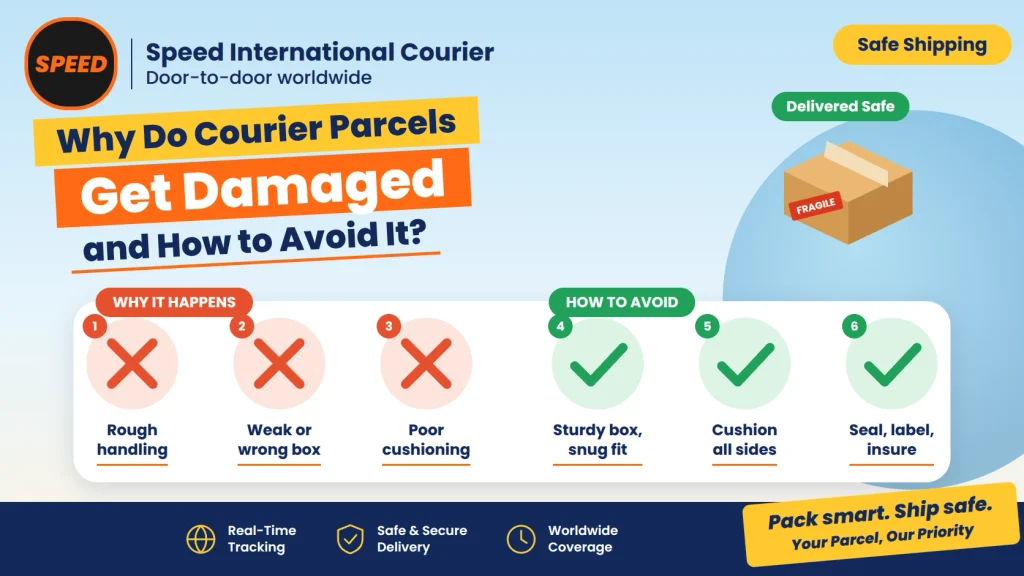
Why Courier Parcels Get Damaged in Transit
Damage rarely comes from one big accident. It usually comes from small, repeated stresses combined with weak packing. These are the main causes.
1. Weak or Reused Boxes
Old boxes lose strength every time they are used. Soft corners, damp cardboard, and worn walls collapse easily when other parcels are stacked on top.
2. Not Enough Cushioning
If an item can move inside the box, it will bump into the walls with every drop, turn, and vibration. Empty space is the biggest enemy of fragile goods.
3. Oversized or Undersized Boxes
A box that is too big lets the contents slide around. A box that is too small leaves no room for cushioning and puts the item under direct pressure.
4. Poor Sealing
Weak or thin tape can peel away, especially on long journeys, leaving the box open or letting items fall out. Using only one strip of tape across the seam is a common mistake.
5. Heavy Stacking and Pressure
Parcels are loaded together in containers and trucks. A light box at the bottom of a pile can be crushed if its walls cannot take the weight above.
6. Rough Handling and Drops
Multiple transfers, conveyor belts, and manual loading mean every parcel will likely be moved, tilted, or dropped at some point. Packing should assume this will happen.
7. Moisture, Heat, and Weather
Rain, humidity, and temperature changes can weaken cardboard, spoil food, melt cosmetics, or damage electronics. Parcels may wait outdoors or in unheated storage during transfers.
8. Leaks From Liquids
Liquids such as oil, perfume, sauces, and shampoo can leak when pressure changes or the container is not sealed properly, damaging everything else in the box.
9. Customs Inspections
Parcels may be opened and checked at customs. If they are not repacked with care, items can shift or break. Packing that is easy to open and close again helps.
10. Unclear Labelling
A missing “fragile” label will not stop damage by itself, but an unreadable address can cause extra handling, rerouting, and delays that add risk.
How to Pack a Parcel Safely: Step by Step
- Choose a strong, new corrugated box with enough room for cushioning on all sides. Double-wall boxes suit heavier or more delicate items.
- Wrap each item separately in bubble wrap, foam, or thick paper so items do not touch each other or the walls.
- Fill the empty spaces with packing paper, air pillows, or foam so nothing can move. Shake the box gently: if you feel movement, add more filling.
- Create a cushion layer at the bottom and top, about 5 cm thick for fragile goods.
- Seal all seams with strong packing tape, using the H-pattern: along the centre seam and both edges, top and bottom.
- Use the box within its limits. Do not overstuff or exceed the recommended weight.
- Label clearly with the receiver’s full address and phone number, the sender’s details, and a copy of the address inside the box.
- Place documents in a waterproof sleeve and attach them securely outside, as instructed by your courier.
Packing Tips for Specific Items
- Glass, ceramics, and handicrafts: Wrap each piece individually, protect corners, and keep at least 5 cm of cushioning around it.
- Electronics: Use anti-static or foam protection, keep batteries secured as your courier advises, and avoid loose cables inside the box.
- Clothes and textiles: Use plastic bags to keep out moisture, and compress lightly without crushing.
- Liquids: Seal caps tightly, wrap in plastic, add absorbent material, and use leak-proof containers. Check first whether your carrier accepts the item.
- Food products: Use airtight, sealed packaging, and check destination rules before sending.
- Artwork and photographs: Use rigid backing, corner protectors, and a waterproof wrap.
- Documents: Use a waterproof sleeve and a stiff envelope so papers do not bend.
Other Ways to Reduce Damage Risk
- Choose the right service. Fragile items usually do better on faster express services with fewer handling stages.
- Do not rely on a “fragile” sticker alone. Packaging, not labels, protects the contents.
- Photograph your packing. Photos of the item, the packing, and the sealed box help if you ever need to make a claim.
- Consider insurance. Declared value and transit insurance can cover loss or damage. Check what is included and what is excluded.
- Keep your tracking number and monitor the parcel, so you can act quickly if something goes wrong.
- Tell the receiver to inspect the parcel on delivery and photograph any visible damage before discarding the packaging.
What To Do If Your Parcel Arrives Damaged
- Do not throw away the packaging. Keep the box, padding, and contents.
- Take clear photos of the outer box, the inside, and the damaged item.
- Contact your courier quickly, since claim windows are limited.
- Provide documents: invoice showing value, tracking number, and photos.
- Follow the claim process with the carrier, and ask about insurance if you purchased it.
How Speed International Courier Can Help
Speed International Courier, based in Bhikhiwind, Punjab, helps individuals, students, families, and businesses ship documents, parcels, and cargo worldwide through DHL, FedEx, Aramex, DPD, SkyNet, UPS, and Speed Post.
- Careful packing: Guidance and materials so fragile and important items arrive intact.
- Quote before pickup: You know the price first, with no surprise charges.
- Tracking to the door: You receive a tracking number when your parcel is dispatched.
- Straight answers on customs: We tell you what is allowed before you pay for shipping.
Not sure how to pack something fragile? Message us before you seal the box.
Frequently Asked Questions (FAQ)
1. Why do courier parcels get damaged? Most damage comes from weak boxes, too little cushioning, empty space inside the box, rough handling, stacking pressure, and moisture, often in combination.
2. Does a “fragile” sticker protect my parcel? It can help, but it is not a guarantee. Strong packaging and proper cushioning matter far more than a label.
3. How much cushioning should I use? For fragile items, aim for about 5 cm of cushioning on every side, and make sure the item cannot move when you shake the box.
4. Can I reuse old boxes? It is safer to use new boxes, because used cardboard loses strength. If you reuse one, make sure it is clean, dry, and structurally firm, and remove old labels.
5. Should I buy insurance for my shipment? For valuable or delicate items, yes. Check the coverage limits and exclusions with your courier before shipping.
6. How should I pack liquids? Use leak-proof containers with tightly sealed caps, wrap them in plastic, add absorbent material, and confirm that your carrier allows the item.
7. What should I do if my parcel arrives damaged? Keep all packaging, take photos, and contact your courier immediately with your tracking number and invoice.
8. Does express service reduce damage risk? Often it helps, because there can be fewer handling stages and faster transit. Packing quality still matters most.
9. Can customs inspection damage my parcel? It can if items are not repacked carefully. Packing that is easy to open and close again helps reduce the risk.
10. Will the courier pack my parcel for me? Speed International Courier offers packing guidance and materials. Ask us about packing when you book.