
If you ship anything abroad other than personal documents, the commercial invoice is the most important paper in your parcel. It tells customs what is inside, who is sending it, who is receiving it, and what it is worth. A small mistake on this one page can lead to a held shipment, extra duty, a fine, or a parcel sent back to you.
The good news is that filling in a commercial invoice is not difficult once you know what each section means. This guide walks you through every field, shows how to describe your goods, and lists the mistakes to avoid.
What Is a Commercial Invoice?
A commercial invoice is a document that records the details of a sale or shipment of goods across borders. Customs authorities in the destination country use it to decide:
- Whether the goods are allowed into the country
- What import duty and taxes apply
- Whether the declared value is reasonable
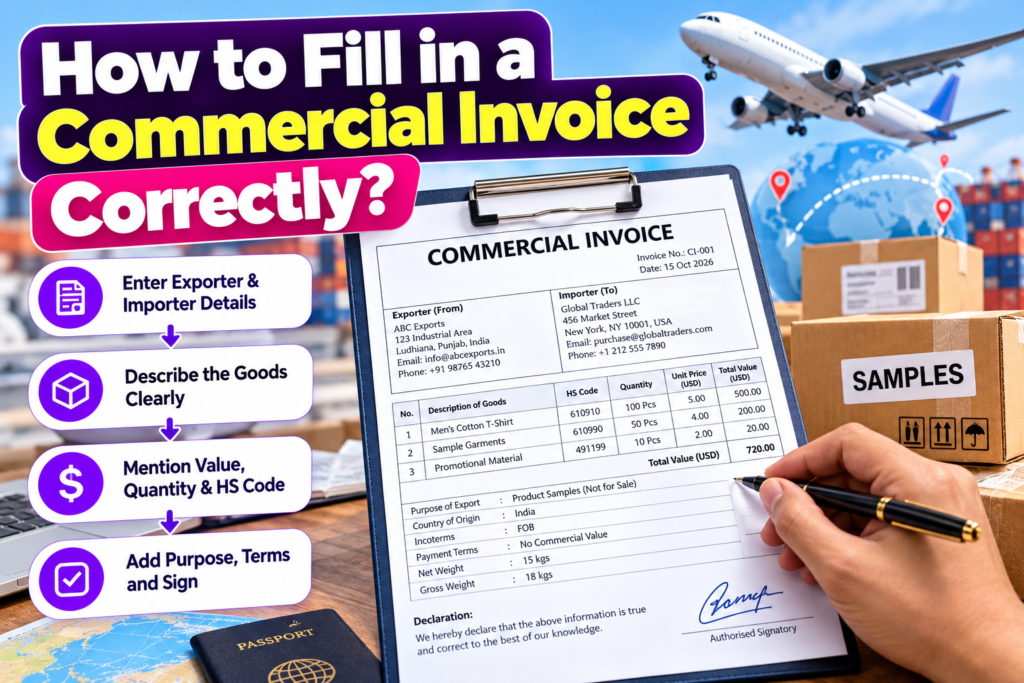
You need one for gifts, samples, personal goods, and business shipments alike. Even when nothing is being sold, customs still expect a clear invoice that explains the contents.
What Information Goes on a Commercial Invoice
While formats vary, a correct commercial invoice includes the following sections.
1. Invoice Number and Date
Give the invoice a unique number and the date of shipping. If you send many parcels, a simple running number such as INV-001, INV-002 keeps your records tidy.
2. Shipper (Exporter) Details
Write the sender’s full name or business name, complete address, phone number, and email. For business exports, add your IEC and GST number where relevant. Use the same name that appears on your ID or KYC documents.
3. Consignee (Receiver) Details
Write the receiver’s full name, street address, city, state, postal code, country, and a working phone number. Some countries also ask for the receiver’s tax ID, VAT number, or import registration number. An incomplete address is one of the biggest causes of delivery failure.
4. Country of Origin and Destination
State where the goods were made (for example, India) and where they are going. Customs use the country of origin to decide duty rates and any trade agreements.
5. Description of Goods
This is where most mistakes happen. Describe each item clearly enough that a customs officer who has never seen it can understand what it is.
- Poor: “Gift”, “Samples”, “Clothes”, “Items”
- Better: “Men’s cotton kurta, blue, size L”
- Better: “Handmade leather juti, women’s, size 7”
Include the material and the use where it matters, such as “stainless steel kitchen knife set” or “cotton bedsheet, double size”.
6. HS Code
The HS (Harmonized System) code is an international number that classifies your product. Customs use it to apply duties and check restrictions. Use the most accurate code you can find for each item. A wrong code can cause delays or incorrect duty.
7. Quantity, Unit Price, and Total Value
List the number of pieces, the price of one piece, and the total for each line. Add them up for a grand total and state the currency (INR, USD, and so on). Always declare the true value. Under-declaring to reduce duty is illegal and can lead to penalties or seizure. Writing a value of zero is usually not accepted, even for gifts and samples, so declare a fair value.
8. Weight and Package Details
Show the net weight of the goods, the gross weight including packaging, and the number of boxes. This should match the actual parcel, because carriers and customs may weigh it.
9. Reason for Export
State why you are sending the goods, such as sale, sample, not for sale, gift, personal effects, or return. Choose the one that is true. Calling a commercial shipment a gift can lead to penalties.
10. Terms of Delivery (Incoterms)
If you are selling, mention who pays freight, duties, and taxes. Two common choices are DAP (the buyer pays duties on arrival) and DDP (you pay duties in advance). Make sure your buyer knows which one applies.
11. Declaration and Signature
Most invoices end with a statement that the information is true and correct, followed by your signature, name, and date. Sign the invoice by hand or add a valid signature.
A Simple Example of a Correctly Filled Line
Here is how a single item line should look:
| Description | HS Code | Qty | Unit Value | Total |
|---|---|---|---|---|
| Men’s cotton kurta, blue, size L | Use the correct code for your item | 2 | INR 800 | INR 1,600 |
HS codes differ by product, so confirm the correct one before you print the invoice.
Tips for a Smooth Customs Clearance
- Print at least 3 copies and keep one for your records
- Make sure every detail matches the parcel: items, quantity, and weight
- Use clear, simple English or the destination’s language when required
- Keep the invoice values consistent with any payment records
- Add the receiver’s phone number so the courier or customs can reach them
- Check whether your product needs extra papers, such as a health certificate for food or herbal products
Common Mistakes to Avoid
- Vague descriptions like “gift” or “samples” for commercial goods
- Declaring zero or a very low value
- Missing or wrong HS codes
- Incomplete receiver address or phone number
- Mismatch between invoice details and the actual contents
- Forgetting to sign the invoice
- Not telling the buyer about possible import duties
How Speed International Courier Can Help
Speed International Courier, based in Bhikhiwind, Punjab, helps individuals, students, families, and businesses send documents, parcels, and cargo to every country through DHL, FedEx, Aramex, DPD, SkyNet, UPS, and Speed Post.
- Invoice and declaration help: We help you prepare the paperwork your shipment needs.
- Quote before pickup: You know the price first, with no surprise charges.
- Straight answers on customs: We tell you what is allowed before you pay for shipping.
- Tracking: You get a tracking number once your parcel is dispatched.
Not sure how to describe your goods? Ask us before you pack.
Frequently Asked Questions (FAQ)
1. What is the difference between a commercial invoice and a proforma invoice? A commercial invoice is the final document for a shipment that is actually being sent. A proforma invoice is a preliminary estimate, often used for quotes or samples. Many couriers accept a proforma invoice for non-sale shipments such as samples and gifts.
2. Do I need a commercial invoice for gifts? Yes. Customs still need to know what is inside and what it is worth, so include an invoice with a fair value, marked as a gift where that is true.
3. Can I write “samples” or “gift” as the description? Not on its own. Describe the actual item, then add the purpose, for example “Cotton kurta, men’s, size L, sample, not for sale”.
4. How many copies of the invoice should I attach? Three copies is a safe standard: one for the carrier, one for customs, and one for the receiver. Your courier can confirm what they need.
5. What currency should I use? Use the currency of the sale, commonly USD, or INR. Always state the currency clearly next to the values.
6. What is an HS code and how do I find it? It is an international product classification code. You can search for it by product type, or ask your courier or customs agent to help confirm the correct one.
7. Is a signature required? Yes. Most carriers and customs offices expect a signed declaration that the invoice details are true.
8. What happens if I make a mistake on the invoice? The shipment may be delayed, held, charged extra duty, or returned. If you notice an error after booking, contact your courier immediately.
9. Who pays the import duty? That depends on the terms you agree. Under DAP the receiver pays on arrival, and under DDP you pay in advance.
10. Can Speed International Courier help me fill in the invoice? Yes. Share your items, values, and destination, and we will guide you on the details customs expect.