
Sending fragile items internationally requires more preparation than shipping ordinary clothes or documents. Whether you are sending glassware to family in Canada, a decorative gift to the UK, ceramic items to Australia, or handmade products to customers overseas, improper packaging can increase the risk of damage during transportation.
International parcels may pass through multiple sorting centres, vehicles and handling systems before reaching their destinations. Fragile items must therefore be protected against shocks, vibration, pressure and movement inside the package.
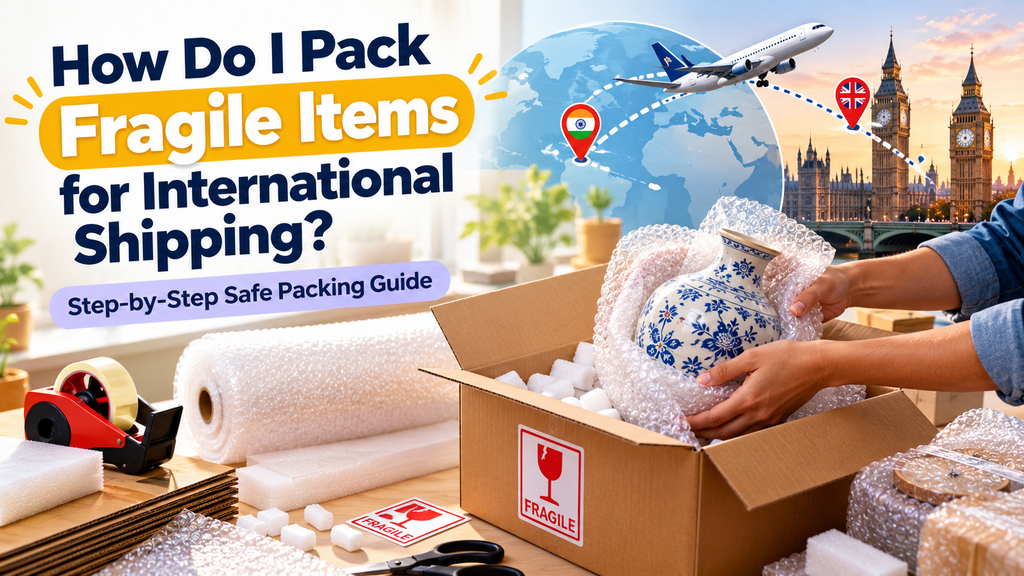
The safest practical way to pack fragile items for international shipping is to wrap each item individually, surround it with suitable cushioning, place it inside a strong box, fill empty spaces, and use double-box packaging for highly delicate products. Proper packing reduces the risk of damage, although it cannot guarantee that an item will arrive unharmed.
At Speed International Courier, customers can enquire about international shipping and packaging requirements.
What Items Are Considered Fragile in International Courier?
Fragile items are products that may break, crack, bend or become damaged when subjected to impact, pressure or vibration.
Common examples include:
- Glassware and glass decorations
- Ceramic cups and plates
- Porcelain gift items
- Decorative handicrafts
- Picture frames and mirrors
- Delicate electronic devices
- Certain musical instruments
- Handmade artwork
- Fragile household accessories
Not every fragile product is automatically accepted by an international courier.
Some items, such as restricted electronics, antiques, artwork or products containing batteries, may require special approval.
Step 1: Choose the Right Packaging Materials
Good packaging begins with suitable protective materials.
Depending on the item, you may need:
- Strong corrugated cardboard boxes
- Bubble wrap or suitable foam wrapping
- Foam inserts or moulded cushioning
- Packing paper
- Strong packing tape
- Corner protectors
- Protective plastic sleeves
- Suitable void-fill material
Avoid relying only on newspaper or thin plastic bags for valuable fragile items.
Use packaging materials that provide both cushioning and structural protection.
Step 2: Wrap Every Fragile Item Separately
If you are shipping multiple glass items, do not allow them to touch one another.
Wrap each product individually with adequate cushioning.
For a ceramic mug, protect the handle carefully and fill the hollow space if appropriate.
For a glass decoration, protect protruding sections and sharp edges.
Use enough material to prevent direct contact between the item and the surrounding box.
The amount of protection required depends on the product’s weight, shape and fragility.
Step 3: Select a Strong Inner Box
Place the wrapped product inside a sturdy corrugated cardboard box.
The box should provide enough room for cushioning on all sides.
Do not allow the fragile object to rest directly against the box walls.
Use foam inserts or suitable packing material to hold the item securely in position.
For heavy or particularly delicate items, consult the carrier’s packaging specifications.
Step 4: Use the Double-Box Packing Method
Double-boxing, also known as the box-in-box method, is a useful technique for highly fragile shipments.
First, place the individually protected item inside a cushioned inner carton.
Seal the inner carton properly.
Next, place that carton inside a larger, strong outer box with cushioning between the two boxes on every side.
This additional protective layer helps absorb impacts during transportation.
The exact gap and cushioning thickness should follow the product’s needs and the selected carrier’s guidance.
Step 5: Fill All Empty Spaces
Empty space allows the contents to move during handling.
Use suitable cushioning materials to fill gaps around the item and between the inner and outer boxes.
Before sealing, gently check whether the contents move inside the package.
If movement is noticeable, add suitable cushioning or adjust the packing arrangement.
Avoid compressing soft cushioning so tightly that it loses its protective function.
Step 6: Seal the Box Securely
Use strong packing tape suitable for the package’s weight.
A common method is H-taping, where the centre seam and edge seams of the box are sealed.
Avoid using string, ordinary household tape or weak adhesive materials as the only way to secure a heavy package.
The outer packaging should remain closed throughout normal courier handling.
Step 7: Label the Parcel Correctly
Attach a clear shipping label containing:
- Recipient’s full name
- Complete delivery address
- Destination postal code
- Country
- Contact number
- Sender’s return details
You may add a “FRAGILE” label when appropriate, but a fragile sticker does not replace protective packaging or guarantee special handling.
Check whether the selected carrier offers any special handling service.
Step 8: Prepare Customs Documents
For international parcel shipping, customs authorities generally require accurate descriptions and values of goods.
For example, instead of writing “gift,” describe the item as “ceramic decorative vase” or “glass photo frame.”
Additional documentation may be required for valuable artwork, antiques, electronics or controlled products.
Always check destination regulations before shipping.
Step 9: Check Shipment Protection and Liability
Fragile items can be expensive or difficult to replace.
Before booking, ask whether the carrier accepts the item and whether loss or damage protection is available.
Some couriers exclude certain fragile products from compensation or apply special packing requirements.
Photograph the item’s condition and packaging before dispatch, and keep the purchase invoice or other proof of value where available.
How Much Does Fragile International Courier Cost?
Shipping charges depend on the weight, dimensions, destination and available delivery service.
Fragile items often need additional cushioning and stronger boxes, which can increase the package’s dimensions.
Many courier services calculate charges based on actual or volumetric weight, whichever is higher.
For a quotation, provide the type of item, packed box dimensions, weight and destination postal code.
Can I Send Fragile Gifts to Canada, UK and Australia?
Many fragile decorative products may be shipped to Canada, the UK or Australia if the courier accepts the item and destination import rules permit it.
However, products made from wood, untreated natural materials, animal-derived materials or other regulated substances may require additional checks.
If the item contains batteries, liquids or hazardous components, special shipping restrictions may apply.
Confirm item acceptance before completing the packaging.
Conclusion
Packing fragile items for international shipping requires careful selection of materials and attention to every stage of preparation. Glassware, ceramics, decorative gifts and delicate products can be damaged by impact or movement if they are not adequately protected inside their shipping containers.
The most effective approach is to wrap each item individually, use strong boxes, fill empty spaces with suitable cushioning, and consider double-box packaging for particularly delicate objects. Accurate labelling, complete customs documentation and an understanding of carrier restrictions are also important parts of a well-prepared shipment.
Speed International Courier assists customers looking for international shipping options for permitted fragile goods from Punjab and other parts of India to Canada, the UK, Australia, the USA and other destinations. Before booking, confirm item acceptance and available protection options.
Frequently Asked Questions
1. What is the best packaging for fragile international parcels?
A strong corrugated box with individual wrapping, suitable cushioning and double-box protection when needed is generally recommended.
2. Can I send glass items from India to Canada?
Some glass items may be accepted. Confirm carrier restrictions, adequate packaging and available shipment protection.
3. Is bubble wrap enough for international shipping?
Not always. Fragile items also need a strong outer box, suitable internal cushioning and protection against movement.
4. Should I write FRAGILE on the package?
Yes, where appropriate, but do not depend on the label alone to protect the contents.
5. Does international courier insurance cover broken items?
Coverage depends on the provider’s terms, exclusions and packaging conditions. Ask before booking.
6. Can I send ceramic gifts to the UK?
Many ceramic gifts can be shipped if the carrier accepts them and the items comply with the destination’s import requirements.
7. Why is double-box packaging recommended?
It provides an additional protective barrier and space for cushioning to absorb impacts during handling.
8. Where can I enquire about fragile parcel courier services?
Contact Speed International Courier with the item’s details, weight and destination.