
When booking an international courier, one of the first questions customers encounter is whether their shipment should be classified as a document or a parcel.
Many people assume that anything inside an envelope is a document, while anything packed in a cardboard box is a parcel. However, international shipping companies classify shipments based on their contents, applicable customs rules, and service conditions—not only their packaging.
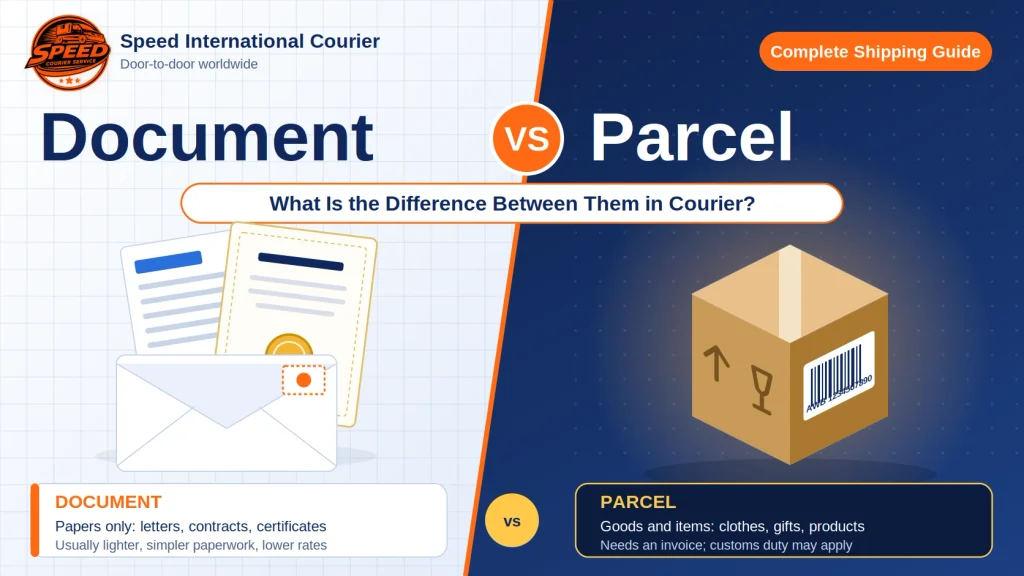
The main difference between a document and a parcel in international courier is that a document shipment generally contains eligible paperwork without commercial merchandise, while a parcel contains physical goods such as clothing, gifts, books, accessories, or other products. The distinction affects shipping documentation, customs clearance, available services, and sometimes courier charges.
At Speed International Courier, customers can enquire about document and parcel shipping from Punjab and other parts of India to international destinations.
What Is a Document Courier?
A document courier service is generally used to transport eligible paper records and correspondence.
Typical examples include:
- Business letters
- Educational certificates
- University transcripts
- Contracts and agreements
- Application forms
- Official correspondence
- Certain legal documents
- Printed reports
Not every paper item automatically qualifies for document classification.
Passports, negotiable financial instruments, original title deeds, and certain other sensitive documents may be subject to special carrier restrictions.
Courier approval should be obtained before sending restricted or high-value records.
What Is a Parcel Courier?
A parcel courier service is generally used for shipping physical goods rather than ordinary correspondence.
Common examples include:
- Punjabi suits and sarees
- Phulkari dupattas
- Birthday and festival gifts
- Books intended as merchandise
- Handicrafts and accessories
- Permitted packaged snacks
- Household products
- Commercial samples
Parcel shipments frequently require more detailed customs declarations, including descriptions, quantities, and declared values.
Some products may require additional approvals, while hazardous or prohibited goods may not be accepted at all.
Document vs Parcel Courier: Key Differences
| Feature | Document Courier | Parcel Courier |
|---|---|---|
| Contents | Eligible papers and correspondence | Physical goods and merchandise |
| Packaging | Usually document envelope | Box, packet, or suitable mailer |
| Customs paperwork | Often simplified | Generally more detailed |
| Declared value | Depends on classification | Usually required |
| Shipping charges | Based on document service and weight | Based on weight, dimensions, and service |
| Restricted items | Special documents may be restricted | Product-specific restrictions apply |
| Typical use | Certificates, contracts, letters | Clothing, gifts, products |
The exact classification depends on the courier provider and destination country’s regulations.
How Are International Courier Charges Calculated?
International courier charges can vary significantly between document and parcel shipments.
For document courier services, charges may depend on the destination country, envelope weight, and selected delivery option.
For parcels, the shipping cost often depends on actual weight or volumetric weight, whichever is greater.
What Is Volumetric Weight?
Volumetric weight represents the amount of space a package occupies during transportation.
A commonly used express courier calculation is:
Volumetric Weight (kg) = Length × Width × Height (cm) ÷ 5000
For example, a box measuring 40 × 30 × 20 cm would have a volumetric weight of 4.8 kg using this divisor.
However, the divisor can vary by courier service and route.
If a box weighs 3 kg physically but has a chargeable volumetric weight of 4.8 kg, the courier may calculate the shipping price using the higher figure.
Do Documents Require Customs Clearance?
International documents can still be subject to screening and regulatory checks.
Eligible non-commercial correspondence may qualify for simplified documentation, depending on the route and carrier.
For goods, customs authorities typically require descriptions, quantities, declared values, and sometimes commercial or proforma invoices.
Important: Placing clothing, gifts, or merchandise inside a document envelope does not convert those goods into a document shipment.
Accurate shipment classification is essential.
Can I Send Documents and Goods Together?
Some customers want to place certificates, letters, clothing, and personal gifts in a single shipment.
Whether this is possible depends on the courier company’s service rules and the nature of the contents.
When documents and physical goods are packed together, the shipment may need to be declared and processed as a parcel rather than a document-only shipment.
Ask the courier provider before combining different categories of goods.
For original documents, separate shipping may be preferable to reduce handling risks.
Which Is Faster: Document Courier or Parcel Courier?
Neither shipment category is automatically faster.
Delivery speed primarily depends on the selected service, destination, courier network, customs requirements, and local delivery conditions.
A document sent through an economy service may arrive later than a parcel sent through an express service.
However, goods requiring customs inspection may experience additional delays compared with uncomplicated document shipments.
Always request a route-specific estimated delivery window.
What Documents Are Needed for International Parcel Shipping?
The paperwork required depends on the shipment contents and destination.
Common details include:
- Sender’s complete name and address.
- Recipient’s address and postal code.
- Sender and recipient contact numbers.
- Accurate description of the contents.
- Item quantities and declared values, where applicable.
- Commercial invoice or proforma invoice, if required.
- Product-specific permits or supporting documents, where applicable.
Incorrect descriptions can cause shipping delays and customs problems.
Why Choose Speed International Courier?
Speed International Courier assists customers seeking international shipping options for permitted documents, clothing, personal gifts, and commercial parcels.
Customers can enquire about appropriate shipment classification, packaging, destination coverage, and available services.
Whether you need to send academic certificates to Canada or Punjabi clothing to the UK, understanding the document-versus-parcel distinction helps you prepare the shipment properly.
Conclusion
Understanding the difference between document and parcel courier services helps customers choose the appropriate shipping method. Documents generally include eligible correspondence, certificates, and paperwork, while parcels contain physical goods such as clothing, gifts, handicrafts, and merchandise. Each category may have different customs and shipping requirements.
Before booking an international shipment, check the contents, packaging, destination, and selected courier service. Accurate classification and customs information help avoid unnecessary delays. Customers should also confirm whether any sensitive documents or regulated products require special approval.
Speed International Courier helps customers explore shipping options for documents and parcels from Punjab and other parts of India to international destinations, including Canada, the UK, Australia, and the USA. For information about shipping charges, document requirements, and available courier services.
Frequently Asked Questions
1. Is a passport considered a document in courier?
A passport is a travel document, but courier companies may treat original passports as restricted items. Always confirm acceptance before shipping.
2. Can I send clothes through document courier?
No. Clothing is normally classified as goods and should be declared through the appropriate parcel service.
3. Are document courier charges cheaper than parcel charges?
They may be, but rates depend on the destination, service, weight, and carrier pricing structure.
4. Do I need a commercial invoice for documents?
Eligible document-only shipments may not require a commercial invoice. Some destinations or document categories can have additional requirements.
5. Can I send university certificates internationally?
Many academic certificates can be shipped internationally, subject to courier acceptance and receiving institution rules.
6. Are books considered documents or parcels?
It depends on the contents, intended use, carrier and destination. Commercial books are generally treated as goods, while certain printed correspondence may qualify as documents.
7. Can I track both document and parcel shipments?
Many international courier services provide tracking for both categories. Confirm the facility when booking.
8. Where can I enquire about document and parcel courier services?
Contact Speed International Courier at https://speedinternationalcourier.com/ for available international shipping options.